The New Wave of WhatsApp Finance Bots
A new type of financial software is quietly growing in Latin America: bots that turn WhatsApp messages into accounting records.
Attention Team4 min read
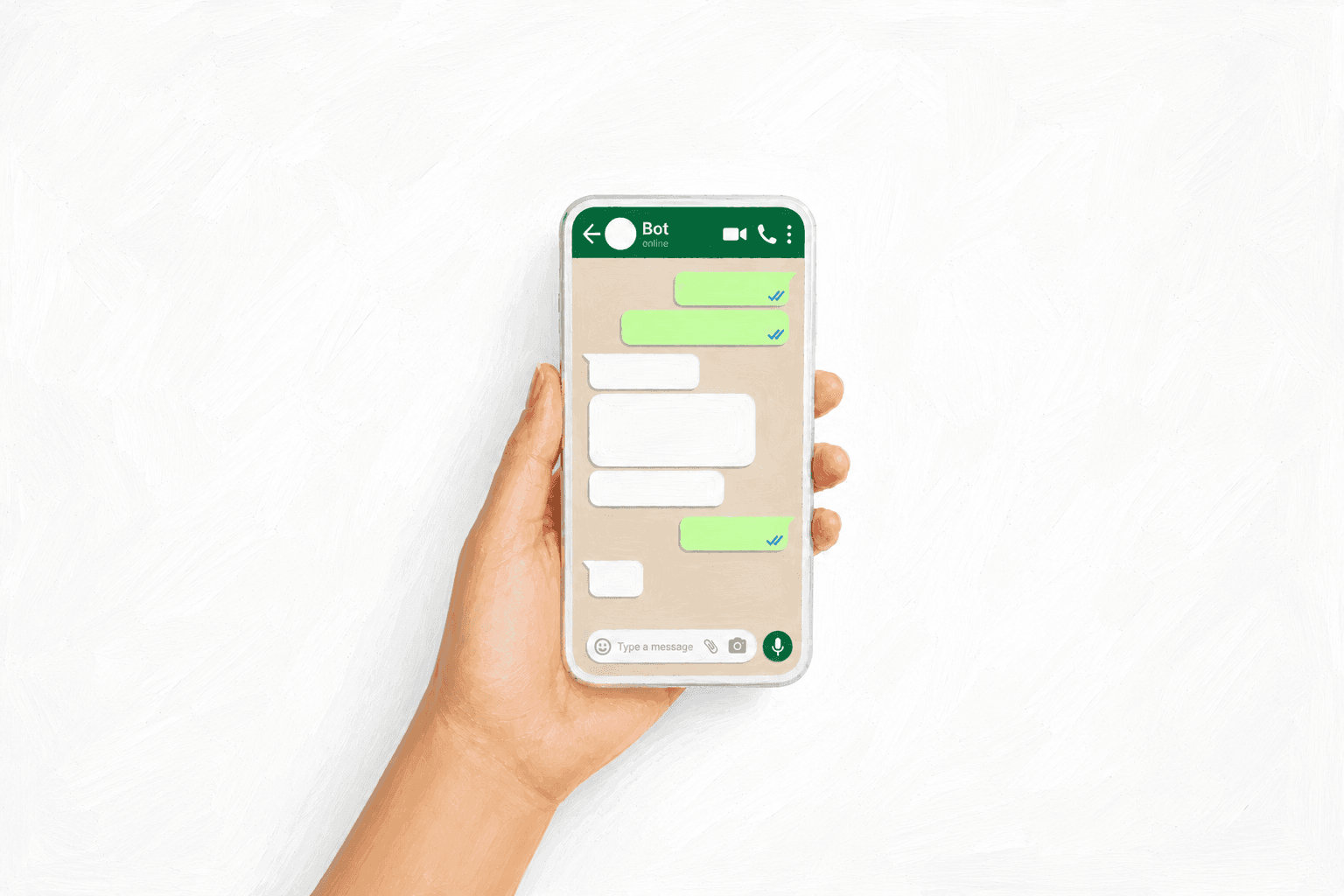
There’s a new type of financial software (most of the time made by content creators) quietly growing in Latin America: bots that turn WhatsApp messages into accounting records.
Some of these products charge between $3 and $10/month, meaning that even 100 paying users can already generate meaningful recurring revenue.
And the concept is easy to understand: You take a photo of a receipt, send a message like “spent $42 on lunch” or forward a banking notification, and the system automatically logs the expense into a financial dashboard.
In the United States, where iMessage and SMS are used, products like Receipt-AI, created by Queenie Peng and Ian Heraty, already exist.
But where this becomes even more interesting is Latin America and Europe. Because here the main interface of the internet is WhatsApp.
Over the last few months I saw how several products built exactly around this idea have started appearing:
UsaPablo, created in August 2025, charges around $5.40/month or $54/year USD. With just 100 paying users on the monthly plan, that’s already around $540 MRR.
Confi, launched in April 2026 by Confesión Financiera, offers multiple tiers: a free plan with limited usage, a PRO plan at around $3.50/month USD, a PREMIUM plan at around $6.20/month USD, plus a BUSINESS tier for companies with 10+ collaborators. Even at the PREMIUM tier alone, 100 paying users would already represent around $620 MRR.
GastiPro, launched in November 2024, offers $6.99 and $9.99 monthly plans along with Wallbit integration. At 100 users paying the highest plan, that’s nearly $1K MRR.
GoClever, launched in February 2026, charges around $3.74/month USD. With 100 paying users, that’s already close to $374 MRR. Besides logging expenses through WhatsApp, it also connects automatically to the user’s personal email to detect bank transactions and register them inside a web dashboard.
All of them share the same idea: You can make your own with your favorite WhatsApp bot automation tool, generate a dashboard and set up prices. So what comes next is…
How to market them?
Of course distribution matters more than technology in this case. And there is so much room to grow. This is what I discovered on TikTok:
Confi got around 59K views on a video using the hook: “There have been a lot of rumors about whether I paid the bank or not…”
GastiPro took an even stranger direction: their most viral videos use the AI-generated gorilla. Their top four videos revolve around that. Absurd humor mixed with finance. They got 62K views.
UsaPablo, on the other hand, leaned into a founder story for 14K views: “Fulfilling your dream is creating an app…”
Each one found a different angle. But all of them connect to the same feeling: financial chaos.
Most of the content creators do have viral videos talking about themes that can also be used now that they have the app to market. They go for things like:
- Not having money
- Problems with the bank
- Impulsive spending (this can be used with advice from bots)
- Jokes about being broke
- The feeling of financial chaos
Since most of them have been working on finance education, it’s really easy to introduce the new tool.
The numbers still work
Even with lower purchasing power in Latin America compared to the United States, the numbers are still interesting. A product charging between $3 and $10 per month can become very profitable with just 1,000 paying users.
Confi is the only product I saw that has a tier for businesses, so it has a lot of potential to grow there as well, with a solution for more people or with some interesting automation.
On top of that, this type of software has a huge advantage: operational marginal costs can remain relatively low (you can use a small fine-tuned model or the latest OpenAI GPT nano model) once the core system is already working.
Even though several players already exist, the market is still enormous. Especially in countries where almost the entire informal economy lives inside WhatsApp, and where most people use TikTok over Instagram.
I also find GoClever’s idea particularly fascinating because it feels closer to an “automatic financial copilot”, as it connects with email providers to detect new expenses, removing the need to manually enter them in WhatsApp.
The case for LATAM
If Receipt-AI managed to reach $1.5K MRR in the United States after launching at the end of 2023, it’s reasonable to think similar businesses could be built in LATAM. Maybe with a lower average ticket size, yes. But also with a culture far more accustomed to using chats as the primary interface for work and daily life.
More from the lab
Trending
The Baseball Trend: How AI Apps Are Using It to Go Viral
AI Video Generator + Creator is ranked #2 in Graphics & Design with $200k revenue last month. One of its TikTok Spark Ads uses the baseball format. Here is what that looks like and why it works.
categories.overview
Welcome to Attention Terminal
What this site is, what we cover, and what you can expect from us.